.png)


 Corporate governance is the cornerstone of responsible business practices, ensuring companies operate transparently, ethically, and in the best interests of stakeholders. Investment advisors play a pivotal role in this framework, acting as intermediaries between corporations and investors, and advocating for sound governance principles. Their expertise influences shareholder decision-making, promotes ethical practices, and ensures long-term financial stability.
This article examines the critical role investment advisors play in corporate governance, detailing their responsibilities, qualifications, and the impact of certifications
Corporate governance refers to the system by which companies are directed and controlled. Its primary objectives include:
Ensuring accountability to stakeholders.
Promoting transparency in decision-making.
Balancing the interests of shareholders, management, and other stakeholders.
Key components of corporate governance include board structure, shareholder rights, ethical practices, and regulatory compliance. Investment advisors contribute to these areas by advising investors and advocating for governance reforms.
Investment advisors act as liaisons between shareholders and corporations, ensuring that corporate policies align with investor expectations. They achieve this by:
Monitoring company performance and governance practices.
Recommending proxy votes on issues such as executive compensation and board elections.
Engaging with management to address shareholder concerns.
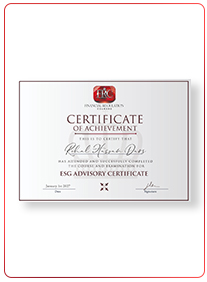
Advisors encourage companies to adopt ethical business practices, such as environmental sustainability and fair labour policies. Certifications like the ESG Advisor Certificate by FRC equip investment advisors with knowledge in Environmental, Social, and Governance (ESG) principles, enabling them to advocate for responsible corporate behaviour.
Investment advisors guide companies in adhering to governance regulations, such as the UK Corporate Governance Code. Their expertise helps corporations avoid legal pitfalls and maintain market integrity.
By analysing financial reports and disclosures, advisors ensure companies provide accurate and timely information to shareholders, fostering trust and confidence.
Investment advisors must possess a blend of academic knowledge, certifications, and practical experience to influence corporate governance effectively.
Degrees in finance, business administration, or law provide the foundational knowledge required for corporate governance roles. Topics such as corporate law, ethics, and financial analysis are particularly relevant.
Certifications play a crucial role in equipping advisors with advanced skills and knowledge. Key certifications include:
CISI Investment Advice Diploma
This certification by the Chartered Institute for Securities & Investment covers investment products, risk management, and regulatory frameworks.
FRC Investment Advisor Certificate and ESG Advisor Certificate (CPD Certification)
Offered by Financial Regulation Courses (FRC), this CPD-accredited program focuses on Investment banking, enabling advisors to promote sustainable corporate practices
CFA (Chartered Financial Analyst)
The CFA qualification provides in-depth training in financial analysis, ethical practices, and corporate finance, essential for governance-related advisory roles.
In the UK, investment advisors must meet the standards set by the Financial Conduct Authority (FCA). This includes passing regulatory exams and participating in Continuing Professional Development (CPD).
Advisors must assess corporate governance structures, evaluate board effectiveness, and identify areas for improvement.
Engaging with boards and influencing corporate decision-making require strong interpersonal skills.
Understanding environmental, social, and governance factors is increasingly critical, as investors demand sustainable and ethical business practices.
Advisors must identify governance-related risks, such as conflicts of interest or non-compliance, and develop strategies to mitigate them.
Advisors advocate for diverse board compositions, recognising that varied perspectives improve decision-making and innovation.
By emphasising sustainable growth over short-term profits, advisors influence companies to adopt long-term strategies that benefit all stakeholders.
Investment advisors hold management accountable for decisions that impact shareholder value, promoting transparency and ethical conduct.
Programs like FRC’s ESG Advisor Certificate prepare advisors to champion sustainability, integrating ESG criteria into corporate governance evaluations.
Advisors often mediate between shareholders demanding returns and management prioritising operational goals.
Evolving governance regulations require advisors to stay updated through CPD and specialised training programs like those offered by FRC.
Implementing ESG principles can be challenging when companies resist change or fail to align with global standards.
Advisors must balance the diverse expectations of institutional investors, retail clients, and regulatory bodies.
To excel in corporate governance, investment advisors must engage in ongoing education and training.
FRC Programs: Financial Regulation Courses provide CPD-accredited training that combines governance knowledge with practical skills. Their ESG Advisor Certificate is particularly valuable for advisors focused on sustainability.
Workshops and Webinars: Topics include corporate ethics, shareholder engagement, and regulatory updates.
Industry Conferences: Networking with governance experts and staying informed about global trends.
Learning from experienced advisors enhances understanding of complex governance scenarios and best practices.
Investment advisors play a critical role in shaping corporate governance by advocating for transparency, promoting ethical practices, and aligning company policies with shareholder interests. Certifications such as the ESG Advisor Certificate offered by Financial Regulation Courses (FRC) equip advisors with the tools to navigate the evolving governance landscape effectively.
By focusing on continuous learning, developing key skills, and addressing governance challenges, investment advisors contribute to a more accountable and sustainable corporate environment, ensuring long-term benefits for companies and stakeholders alike.
Be the first to know about new class launches and announcements.


Financial writer and analyst Ron Finely shows you how to navigate financial markets, manage investments, and build wealth through strategic decision-making.
See why leading organizations rely on FRC for learning & development.